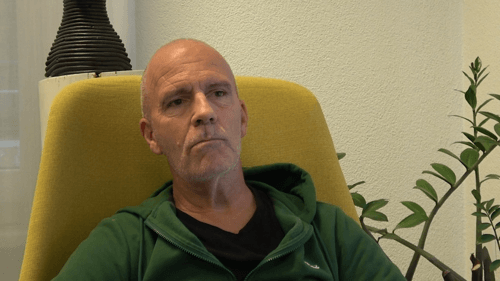
Steiner (Betroffener)
At the age of 52, Mr Steiner suffered a stroke. When he went to the toilet one night, he realised that his leg was paralysed, he could no longer walk properly and he had to vomit. His ex-partner called an ambulance immediately. In hospital, he suffered a second stroke, which caused severe word-finding difficulties. Mr Steiner has few memories of the acute phase of his illness and the subsequent rehabilitation. The cause was probably a rare blood disorder affecting the coagulation system. During rehabilitation, he had to relearn how to walk: first in a wheelchair, then with a walking frame. He continues to suffer from balance problems, but was able to learn to ride a bike again. After four months, he completed his rehabilitation stay. His speech was severely impaired, so with the help of speech therapy, he invested a lot of time in speech exercises and reading aloud. He continues to attend physiotherapy as he repeatedly suffers from muscle spasms. He has also had to relearn everyday tasks such as using his mobile phone or going shopping. Sometimes he finds it difficult to find his way around the supermarket. Taking beta-blockers further restricts his sporting activities. Even after seven years, his physical and speech abilities remain highly dependent on how he feels on any given day. Mr Steiner has a living will because he is certain that he does not wish to continue living in a vegetative state. The will is held by his sister, who also supports him with administrative tasks. He is aware of how stressful it can be for relatives to care for a loved one in a drastically altered state and in a life-threatening situation. Professionally, Mr Steiner worked as a stage performer and comedian. When attempting to return to the stage, he realised that not only was his speech impaired, but the long recovery periods were also no longer compatible with the stage programme. Sport had always been important to him, but here too he had to make compromises. The interview took place seven years after the incident on the university premises. At that time, Mr Steiner was living in a flat in the city and receiving disability benefit.
VIDEO
The importance of exercise for physical stability
For Mr Steiner, daily exercise is important for maintaining his mobility. He finds that regular physical activity helps to ensure he remains mobile in his daily life. On days when he lacks the motivation to exercise, however, he notices that his physical abilities deteriorate. Climbing stairs is particularly difficult for him on such ‘bad days’.
Video Interview
TRANSCRIPT
Related experiences

Soldo (Angehörige, Tochter)
"Now she is simply bedridden"
Ms. Soldo reacts with her eyes to familiar voices. She gets pressure marks everywhere from lying down and her joints are stiff. The daughter does not know if her mother can understand her surroundings.
Challenges after brain damage

Gerber (Angehöriger, Sohn)
He showed no reaction
Reactions are vital signs in which perception, nerves and muscles interact. It became apparent in the first few days that Mr. Gerber was not responding to any stimuli. The family decided not to keep the life-support machines running.
Challenges after brain damage
Other experiences by Steiner (Betroffener)
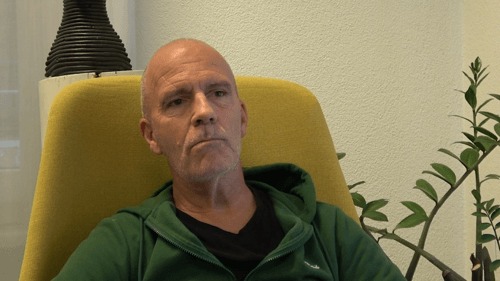
Steiner (Betroffener)
At the age of 52, Mr Steiner suffered a stroke. When he went to the toilet one night, he realised that his leg was paralysed, he could no longer walk properly and he had to vomit. His ex-partner called an ambulance immediately. In hospital, he suffered a second stroke, which caused severe word-finding difficulties. Mr Steiner has few memories of the acute phase of his illness and the subsequent rehabilitation. The cause was probably a rare blood disorder affecting the coagulation system. During rehabilitation, he had to relearn how to walk: first in a wheelchair, then with a walking frame. He continues to suffer from balance problems, but was able to learn to ride a bike again. After four months, he completed his rehabilitation stay. His speech was severely impaired, so with the help of speech therapy, he invested a lot of time in speech exercises and reading aloud. He continues to attend physiotherapy as he repeatedly suffers from muscle spasms. He has also had to relearn everyday tasks such as using his mobile phone or going shopping. Sometimes he finds it difficult to find his way around the supermarket. Taking beta-blockers further restricts his sporting activities. Even after seven years, his physical and speech abilities remain highly dependent on how he feels on any given day. Mr Steiner has a living will because he is certain that he does not wish to continue living in a vegetative state. The will is held by his sister, who also supports him with administrative tasks. He is aware of how stressful it can be for relatives to care for a loved one in a drastically altered state and in a life-threatening situation. Professionally, Mr Steiner worked as a stage performer and comedian. When attempting to return to the stage, he realised that not only was his speech impaired, but the long recovery periods were also no longer compatible with the stage programme. Sport had always been important to him, but here too he had to make compromises. The interview took place seven years after the incident on the university premises. At that time, Mr Steiner was living in a flat in the city and receiving disability benefit.
Steiner (Betroffener)
In the case of a stroke, every minute counts.
When Mr Steiner tried to get up in the middle of the night, his leg suddenly went numb and he felt very sick.
Experience of disease
Brain damage
Steiner (Betroffener)
Mr Steiner suffered a second stroke while in the hospital
Mr Steiner did not realise that he was losing the ability to speak. The nursing staff recognised the situation immediately and called a doctor to his bedside.
Experience of disease
Brain damage
Steiner (Betroffener)
"I was a vegetable"
Looking back, Mr Steiner describes himself during the acute phase of his illness as a “vegetable” – an expression that, for him, symbolises a state in which he was no longer able to grasp parts of his own perception. Despite his otherwise humorous personality, he reports that he felt no sense of humour whatsoever during this time.
Experience of disease
Brain damage
Steiner (Betroffener)
Physiotherapy, occupational therapy, speech therapy, and singing lessons
Over a period of two years, Mr Steiner received weekly physiotherapy, occupational therapy and speech therapy sessions to aid his recovery following a stroke. Today, he only attends physiotherapy sessions to have painful or cramped areas of his body treated. With regard to his language skills, he reports that he benefited particularly from a singing teacher whose approach differed significantly from that of the speech therapist and gave him new insights into how to use language.
Procedure after brain damage
Brain damage
Steiner (Betroffener)
“You make the most progress at the beginning”
Mr Steiner learnt to walk again during his rehabilitation. At first he was confined to a wheelchair, and later used a walking frame. Although his mobility remains limited, by the time of the interview he was once again able to walk unaided – though not to jog. He found the rehabilitation very strenuous, as he had several therapy sessions every day. Speech therapy was particularly helpful for him, as he had difficulty speaking.
Procedure after brain damage
Brain damage
Steiner (Betroffener)
“Sometimes those around the patient need more help than the patient themselves”
Mr Steiner describes the enormous strain placed on his family members, who witnessed the critical situation while fully aware of what was happening. He explains that one of his relatives accompanied him in the ambulance as the sirens blared. At such moments, the gravity of the situation becomes very clear to family members.
Decision-making
Brain damage
Steiner (Betroffener)
A plateau in recovery
During the acute phase, Mr Steiner looked to the future with optimism and expected to recover quickly from his stroke. Two years on, he is glad that he did not realise at the time just how much his daily life would be affected by long-term limitations.
Decision-making
Brain damage
Steiner (Betroffener)
Mr Steiner would not have been able to call the emergency services
At the time of the stroke, Mr Steiner was living with his ex-girlfriend. When he realised something was wrong, he called her. She immediately called an ambulance.
Decision-making
Brain damage
Steiner (Betroffener)
Mr Steiner finds religion interesting
Religion and faith play no part in Mr Steiner’s life. Nevertheless, he is interested in how other people draw strength from their faith. That is why he frequently seeks out conversations on matters of faith and occasionally reads religious texts.
Faith, religion, and spirituality
Brain damage
Steiner (Betroffener)
Reading aloud as a daily exercise
Mr Steiner practises every day to regain his ability to speak. Reading aloud is particularly helpful for him.
Lessons and strategies
Brain damage
Steiner (Betroffener)
When the sister becomes a pillar of support
Since his stroke, his sister has been handling the administrative tasks.
Impact for loved-ones
Brain damage
Steiner (Betroffener)
The importance of exercise for physical stability
For Mr Steiner, daily exercise is important for maintaining his mobility. He finds that regular physical activity helps to ensure he remains mobile in his daily life. On days when he lacks the motivation to exercise, however, he notices that his physical abilities deteriorate. Climbing stairs is particularly difficult for him on such ‘bad days’.
Challenges after brain damage
Brain damage
Steiner (Betroffener)
Re-learning everyday tasks
Using the example of shopping, Mr Steiner describes how he had to relearn everyday tasks following his brain injury. What used to come naturally suddenly presented many challenges.
Challenges after brain damage
Brain damage
Steiner (Betroffener)
A thought-free state
Mr Steiner describes how, after his stroke, he sometimes felt as though his head was simply empty and he didn’t need to think. Although he found this state unsettling at times, it meant he could fall asleep without his mind racing as soon as he lay down. At the same time, however, he also experiences the opposite, where his thoughts bounce around his head like a ‘pinball’.
Challenges after brain damage
Brain damage
Steiner (Betroffener)
Mr Steiner no longer felt comfortable behind the wheel
After his stroke, Mr Steiner took some extra driving lessons to see if he was still able to drive. For a while, he continued to travel around the south in a camper van. However, when he realised that he no longer felt comfortable on narrow roads, he decided to sell the camper van. Since then, he has mainly been getting about by public transport and on his bike.
Challenges after brain damage
Brain damage
Steiner (Betroffener)
Return to the stage and personal boundaries
Mr Steiner wanted to return to the stage after his stroke. With the help of his manager at the time, he performed a play about his stroke. Although he thoroughly enjoyed the first performance, he was unable to continue with the stage programme in the long term. In the days that followed, he was no longer able to carry on with his daily work routine, meaning he could not commit to any further performances.
Challenges after brain damage
Brain damage
Steiner (Betroffener)
Mr Steiner measures his quality of life against an imaginary benchmark
Mr Steiner looks back on a life as an artist in which he has had a great deal of fun. He describes his current quality of life as relatively good. He has learnt that bad days are always followed by good ones.
Challenges after brain damage
Brain damage
© 2000-2021, All Rights Reserved