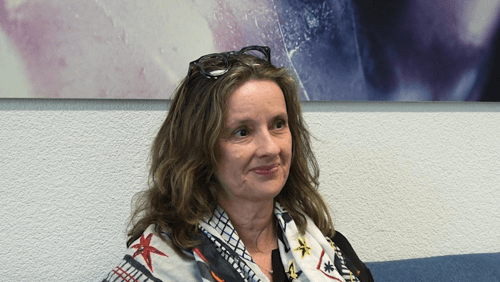
Huber (Betroffene)
At the age of 50, Mrs Huber developed a melanoma at the back of her head, caused by malignant melanoma. At first, she thought the symptoms were simply a stiff neck. The symptoms worsened: nausea, ravenous hunger and increasing headaches. Following a misdiagnosis at the A&E department, imaging was only carried out after her second visit to the doctor. This revealed a 5 cm tumour, which required emergency surgery. The operation was delayed due to her medication, so she was kept under observation for a few days. During her stay in hospital, she was acutely aware of her surroundings and remained positive despite everything. She appreciated the support of her family and the care of a nurse when she suddenly became anxious. Mrs Huber is married, has two children and a dog. Before the operation, her husband tried to discuss possible decisions with her; she now has a living will. The operation went well, yet some limitations remained: reduced function in her left hand, a restricted field of vision, and problems with temporal and spatial orientation. She declined a stay at the rehabilitation clinic and wanted to put the matter behind her. The limitations still make her angry to this day, especially when she cannot carry out tasks as she used to. She developed strategies for everyday life, such as having a maximum of one appointment per half-day and preparing the evening before. When dealing with her family, she sometimes wishes she had her former patience back. Before her illness, she worked as a speech therapist specialising in reading, maths and writing difficulties and also had training in graphic and web design. However, returning to work quickly revealed her limitations, meaning she now has to consider applying for a disability pension. At the time of the interview, Ms Huber was 54 years old. The interview took place at the University of Zurich.
VIDEO
Mrs. Huber gets angry when she is unable to perform certain actions in a targeted manner
Compared to other people with brain injuries, Mrs Huber feels that her own limitations are less severe.
Video Interview
TRANSCRIPT
Related experiences
Suter (Betroffener)
I had a "storybook brain haemorrhage"
Mr. Suter is grateful about his disease progression - especially compared to the severely affected people he saw in the rehabilitation clinic.
Decision-making
Soldo (Angehörige, Tochter)
"Her life is somehow no longer worth living"
Ms. Soldo describes in a few words the apathy of her mother, interpreting it as if she had already “left” while still alive.
Decision-making
Other experiences by Huber (Betroffene)
Huber (Betroffene)
At the age of 50, Mrs Huber developed a melanoma at the back of her head, caused by malignant melanoma. At first, she thought the symptoms were simply a stiff neck. The symptoms worsened: nausea, ravenous hunger and increasing headaches. Following a misdiagnosis at the A&E department, imaging was only carried out after her second visit to the doctor. This revealed a 5 cm tumour, which required emergency surgery. The operation was delayed due to her medication, so she was kept under observation for a few days. During her stay in hospital, she was acutely aware of her surroundings and remained positive despite everything. She appreciated the support of her family and the care of a nurse when she suddenly became anxious. Mrs Huber is married, has two children and a dog. Before the operation, her husband tried to discuss possible decisions with her; she now has a living will. The operation went well, yet some limitations remained: reduced function in her left hand, a restricted field of vision, and problems with temporal and spatial orientation. She declined a stay at the rehabilitation clinic and wanted to put the matter behind her. The limitations still make her angry to this day, especially when she cannot carry out tasks as she used to. She developed strategies for everyday life, such as having a maximum of one appointment per half-day and preparing the evening before. When dealing with her family, she sometimes wishes she had her former patience back. Before her illness, she worked as a speech therapist specialising in reading, maths and writing difficulties and also had training in graphic and web design. However, returning to work quickly revealed her limitations, meaning she now has to consider applying for a disability pension. At the time of the interview, Ms Huber was 54 years old. The interview took place at the University of Zurich.
Huber (Betroffene)
Point of contact for loved ones
Following her cancer diagnosis, Ms Huber and her family were assigned a dedicated contact person who helped them adapt their daily lives to the new situation. It was particularly important that this person was willing to listen to their concerns and questions and helped the family cope with the challenges brought about by the illness.
Procedure after brain damage
Brain damage
Huber (Betroffene)
Orientation aids in the intensive care unit
At first, Mrs Huber felt disoriented and anxious in the intensive care unit. She was grateful for the helpful guidance and clear explanations regarding the ongoing medical treatment, which helped her to find her bearings.
Procedure after brain damage
Brain damage
Huber (Betroffene)
“I had the feeling he was looking forward to the operation.”
Ms Huber was briefed by the surgeon about the upcoming operation. During this discussion, she learnt where the tumour was located, how the operation would be carried out, and what the risks involved were. This information helped her to better understand the situation. Overall, she trusted the surgeon, as she perceived him to be competent.
Decision-making
Brain damage
Huber (Betroffene)
Compared to others, Mrs Huber took her condition less seriously.
Mrs Huber took her cue from the condition of the other patients on the ward. By comparison, she took her own situation less seriously, which shows just how strongly her perception was influenced by interacting with and observing others.
Decision-making
Brain damage
Huber (Betroffene)
Back home, her family cried a lot.
It was only afterwards that Mrs Huber realised the heavy burden this had placed on the family.
Decision-making
Brain damage
Huber (Betroffene)
"Perhaps I’ve pushed it out of my mind."
Before the operation, Mrs Huber was unaware of how uncertain her prognosis was and that a poor outcome was possible. Before the procedure, her husband couldn’t find the right words to talk to her about the possible implications for the future.
Decision-making
Brain damage
Huber (Betroffene)
She only underwent an imaging scan during her second visit to the doctor
As her GP was unavailable, Mrs Huber had to visit another surgery where the staff did not know her. She was given painkillers and balance exercises and sent home. It was only during her second visit that the doctor on duty took action, as Mrs Huber was exhibiting symptoms typical of a neurological condition.
Decision-making
Brain damage
Huber (Betroffene)
Mrs Huber used to have one appointment after another
Ms Huber has learnt to reorganise her daily routine. She now allows considerably more time for appointments than she used to. In doing so, she compares her organisational skills with those she had before her brain injury and realises just how much her planning has changed.
Identity
Brain damage
Huber (Betroffene)
Delimitation
Mrs Huber learned to set better boundaries
Lessons and strategies
Brain damage
Huber (Betroffene)
Tea and a chat: a small gesture with a big impact
Mrs Huber was very anxious before the operation. It helped her a great deal when a nurse brought her some tea, sat down with her and listened attentively.
Lessons and strategies
Brain damage
Huber (Betroffene)
A message for the worst-case scenario
Mrs Huber left a message for her children in case she did not wake up after the operation.
Impact for loved-ones
Brain damage
Huber (Betroffene)
Restricted visual field
Since her operation, Mrs Huber has had a restricted field of vision. This visual impairment affects various everyday situations. She illustrates this particularly clearly using the example of food preparation: tasks such as chopping food are more difficult for her, as she cannot reliably see things in the lower part of her field of vision
Challenges after brain damage
Brain damage
Huber (Betroffene)
Mrs. Huber gets angry when she is unable to perform certain actions in a targeted manner
Compared to other people with brain injuries, Mrs Huber feels that her own limitations are less severe.
Decision-making
Brain damage
Huber (Betroffene)
Problems with orientation
Since her operation, Ms Huber has found it difficult to find her way around both virtual and physical environments. This is evident, for example, when she works on the computer, where she struggles to navigate between programmes or use the keyboard. She experiences similar problems in large car parks, where she struggles with spatial orientation. At the same time, she reflects critically on this experience and notes that difficulties with orientation in such situations may also be part of her personality.
Challenges after brain damage
Brain damage
© 2000-2021, All Rights Reserved