
Brunner (Betroffener und Angehöriger, Partner)
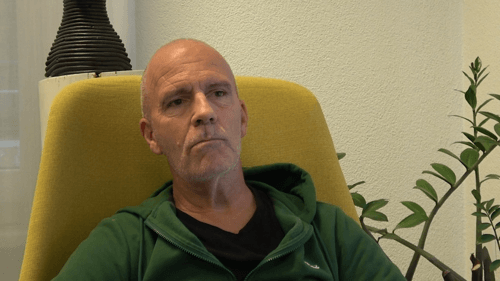
At the age of 29, Mr. Brunner was diagnosed with a slow-growing brain tumor, which generally has a good prognosis following surgical removal. Looking back, he had already been suffering from epileptic seizures for several years, which had frequently manifested as brief “absences.” These absences were likely caused by the tumor. On the recommendation of his treatment team, he decided to undergo surgical removal of the tumor. Complications arose during the procedure: surgery-related vascular damage led to a severe stroke.
TEXT
An artery was damaged during the operation
Mr Brunner suffered regular ‘absences’ due to epileptic seizures caused by a brain tumour. To reduce or prevent the seizures, Mr Brunner underwent neurosurgery. Complications arose during this operation: surgical damage to a blood vessel led to a severe stroke. This complication resulted in long-term paralysis, which affects his quality of life.
TRANSCRIPT
Related experiences
Steiner (Betroffener)
Mr Steiner suffered a second stroke while in the hospital
Mr Steiner did not realise that he was losing the ability to speak. The nursing staff recognised the situation immediately and called a doctor to his bedside.
Experience of disease
Brunner (Betroffene und Angehörige, Partnerin)
Pain, loss of control and helplessness during an epileptic seizure
Ms Brunner describes an epileptic seizure that she was fully conscious of during consciously experienced, following after her stroke. The seizure was a distressing complication for her, accompanied by intense pain, a feeling of losing control and a profound sense of helplessness. These subjective experiences highlight the emotional and physical dimensions of such neurological sequelae.
Experience of disease
Other experiences by Brunner (Betroffener und Angehöriger, Partner)
Brunner (Betroffener und Angehöriger, Partner)
At the age of 29, Mr. Brunner was diagnosed with a slow-growing brain tumor, which generally has a good prognosis following surgical removal. Looking back, he had already been suffering from epileptic seizures for several years, which had frequently manifested as brief “absences.” These absences were likely caused by the tumor. On the recommendation of his treatment team, he decided to undergo surgical removal of the tumor. Complications arose during the procedure: surgery-related vascular damage led to a severe stroke.
Brunner (Betroffener und Angehöriger, Partner)
Epilepsy as a warning sign of a brain tumour
A benign tumour always caused Mr Brunner to have blackouts
Experience of disease
Brain damage
Brunner (Betroffener und Angehöriger, Partner)
Since falling ill, Mr Brunner sees the world through different eyes
Since completing his rehabilitation, Mr Brunner has been enjoying conversations with others and the beautiful moments spent in nature much more.
Experience of disease
Brain damage
Brunner (Betroffener und Angehöriger, Partner)
An artery was damaged during the operation
Mr Brunner suffered regular ‘absences’ due to epileptic seizures caused by a brain tumour. To reduce or prevent the seizures, Mr Brunner underwent neurosurgery. Complications arose during this operation: surgical damage to a blood vessel led to a severe stroke. This complication resulted in long-term paralysis, which affects his quality of life.
Experience of disease
Brain damage
Brunner (Betroffener und Angehöriger, Partner)
Not a day goes by without me feeling tense
Mr Brunner attends physiotherapy sessions regularly due to spasticity.
Procedure after brain damage
Brain damage
Brunner (Betroffener und Angehöriger, Partner)
Mr Brunner was unable to move when he arrived at the rehabilitation center
Mr Brunner spent three months in rehabilitation. At the start, he was completely unable to move and had lost sensation in certain parts of his body. During his stay, he focused primarily on regaining his motor skills. Step by step, he regained his mobility and sensation. It was particularly important to him that the rehabilitation centre was close to his home.
Procedure after brain damage
Brain damage
Brunner (Betroffener und Angehöriger, Partner)
Altered gait pattern
Mr Brunner suffers from spasticity, which worsens when he is under stress. These muscle spasms have a significant impact on his gait, meaning that the changes are noticeable to others.
Identity
Brain damage
Brunner (Betroffener und Angehöriger, Partner)
Workload, cognitive difficulties and lack of support
Mr Brunner worked as a nursing assistant in a hospital ward. After just half a day’s work, he was so exhausted that all he could do afterwards was sleep. In addition, he found it difficult to carry out even routine tasks reliably. Tasks such as making phone calls were difficult for him, as he was unable to remember dates and names sufficiently. Although he spoke openly about these problems, he received no support from his employer at the time. Consequently, he was unable to continue in the role in the long term.
Challenges after brain damage
Brain damage
Brunner (Betroffener und Angehöriger, Partner)
A new definition of quality of life
Mr Brunner describes how his illness has changed his perspective on quality of life. Today, he sees many things in a very positive light and appreciates the little things in everyday life.
Challenges after brain damage
Brain damage
Brunner (Betroffener und Angehöriger, Partner)
The crisis taught him to appreciate life
Mr Brunner has noticed positive changes in his life. He has realised that his life journey has shaped his view of the world.
Lessons and strategies
Brain damage
© 2000-2021, All Rights Reserved