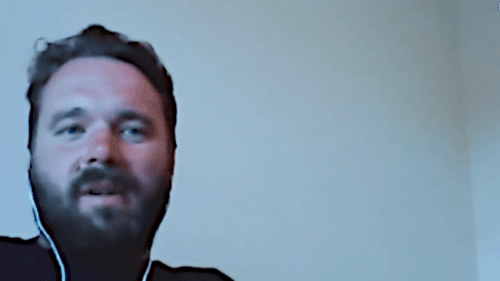
Suter (Betroffener)
Mr. Suter had a subarachnoid haemorrhage in January 2020. The symptoms started at the company party when he was in the bathroom. He immediately realised that something was wrong and called his partner. When the ambulance arrived, he was still responsive but suffered from a hearing loss and kept vomiting. Overall, he made a very good recovery, although it was only in retrospect that he realised how bad he was during the acute phase. Mr. Suter was 38 years old at the time of the event and worked as a carpenter. He lived with his partner and his daughter, who was 5 at the time of the incident. A year after the haemorrhage, he was doing so well that he pursued his dream and started his own business as a carpenter. The haemorrhage taught him that life can end at any time. Since then, he has taken everyday problems less seriously. He handles difficult situations with a great deal of humour and by trying not to overthink everything. The interview took place online in May 2021 under a very poor connection, which is why there are repeated interruptions of words and delays.
VIDEO
"So it's really been getting worse by the second"
The aneurysm ruptured at his company party. Mr. Suter suddenly had a severe headache, dizziness, loss of balance, nausea and a sudden loss of hearing. He contacted his partner, who immediately called an ambulance.
Video Interview
TRANSCRIPT
Related experiences

Novak (Betroffene)
"Something has burst"
Ms. Novak felt a burst in her head while working and called her colleagues for help. Within a very short time, she lost control of her body.
Experience of disease
Soldo (Angehörige, Tochter)
"Just another morning"
The sister-in-law immediately called an ambulance when she found her mother-in-law unconscious.
Experience of disease
Other experiences by Suter (Betroffener)
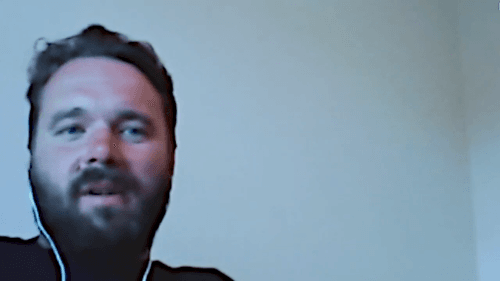
Suter (Betroffener)
Mr. Suter had a subarachnoid haemorrhage in January 2020. The symptoms started at the company party when he was in the bathroom. He immediately realised that something was wrong and called his partner. When the ambulance arrived, he was still responsive but suffered from a hearing loss and kept vomiting. Overall, he made a very good recovery, although it was only in retrospect that he realised how bad he was during the acute phase. Mr. Suter was 38 years old at the time of the event and worked as a carpenter. He lived with his partner and his daughter, who was 5 at the time of the incident. A year after the haemorrhage, he was doing so well that he pursued his dream and started his own business as a carpenter. The haemorrhage taught him that life can end at any time. Since then, he has taken everyday problems less seriously. He handles difficult situations with a great deal of humour and by trying not to overthink everything. The interview took place online in May 2021 under a very poor connection, which is why there are repeated interruptions of words and delays.
Suter (Betroffener)
"So it's really been getting worse by the second"
The aneurysm ruptured at his company party. Mr. Suter suddenly had a severe headache, dizziness, loss of balance, nausea and a sudden loss of hearing. He contacted his partner, who immediately called an ambulance.
Experience of disease
Brain damage
Suter (Betroffener)
The first shower afterwards!
The monitoring in the intensive care unit gave Mr. Suter the feeling of living in a high-security wing. When he was allowed to shower again after two weeks, he could not believe his luck.
Experience of disease
Brain damage
Suter (Betroffener)
"I completely overestimated myself"
In retrospect, Mr. Suter realised that he had overestimated his state of health. After repeating the same test over several weeks and seeing the different results, he realised that he had overestimated himself during the acute phase of his illness.
Experience of disease
Brain damage
Suter (Betroffener)
And then it became "very critical again"
After the operation, the pressure in Mr. Suter's head continued to rise, so he needed another tube to drain cerebrospinal fluid.
Experience of disease
Brain damage
Suter (Betroffener)
As he said goodbye to his family, he "prepared to die"
When the aneurysm burst, Mr. Suter knew intuitively that he might not survive. He said goodbye to his family, saying that they would make it without him.
Experience of disease
Brain damage
Suter (Betroffener)
"A panic attack somehow out of nowhere"
Mr. Suter remembers having a panic attack when he was back home. He would have preferred to call the ambulance. His wife was able to calm him down.
Challenges after brain damage
Brain damage
Suter (Betroffener)
Mr. Suter became self-employed a year after the bleeding
Mr. Suter had a staggered entry into work and, in retrospect, entered the world of work far too quickly. Only with much distance does he see that he should have taken more time.
Challenges after brain damage
Brain damage
Suter (Betroffener)
"It has been by far the worst for my wife".
Mr. Suter describes the perspective of his wife, who, as an outsider, could simply wait and see, without knowing how her husband would be after the operation.
Impact for loved-ones
Brain damage
Suter (Betroffener)
His daughter was still too young to realise the seriousness of the situation
When Mr. Suter was admitted to hospital, his daughter was five years old - old enough to understand that something had happened, but too young to grasp the full extent of it.
Impact for loved-ones
Brain damage
Suter (Betroffener)
"I am doing better now than before"
After Mr. Suter experienced in his own body how quickly life can end, he gives less weight to everyday worries.
Lessons and strategies
Brain damage
Suter (Betroffener)
It is Humour when you laugh anyway
Mr. Suter doesn't question much and tries to take even difficult situations with humour. It helps him if he focuses on positive things.
Lessons and strategies
Brain damage
Suter (Betroffener)
The worst was lying down
Mr. Suter thought it was terrible to have to lie around for two weeks. He is aware that this is a minor problem compared to the diagnosis.
Procedure after brain damage
Brain damage
Suter (Betroffener)
Mr. Suter is very enthusiastic about the nursing staff
Mr. Suter emphasises how well and motivated he was cared for in the hospital. He also sees that this care has a positive effect on the healing process.
Procedure after brain damage
Brain damage
Suter (Betroffener)
Rehab "brings you a lot"
Mr. Suter sees retrospectively how much the rehabilitation supported his healing process, even if he underestimated it at the beginning. The time to concentrate on his recovery outside of everyday life was very important for him.
Procedure after brain damage
Brain damage
Suter (Betroffener)
"You are not allowed to do anything"
Mr. Suter describes how he was monitored during his stay in the intensive care unit and speaks of "total surveillance".
Procedure after brain damage
Brain damage
Suter (Betroffener)
Mr. Suter values clear communication
Mr. Suter experienced the conversations with the medical service as caring and direct and emphasises how important this is.
Decision-making
Brain damage
Suter (Betroffener)
I had a "storybook brain haemorrhage"
Mr. Suter is grateful about his disease progression - especially compared to the severely affected people he saw in the rehabilitation clinic.
Decision-making
Brain damage
Suter (Betroffener)
I am a very simple person
Mr. Suter compares himself to the time before the haemorrhage. It is important to him not to question much and also sees this as a disease management skill.
Identity
Brain damage
Suter (Betroffener)
"I am open to everything. Except for religion"
Mr. Suter distances himself from religious and spiritual thoughts and accepts ‘bad luck’ without putting it in a spiritual context.
Faith, religion, and spirituality
Brain damage
© 2000-2021, All Rights Reserved