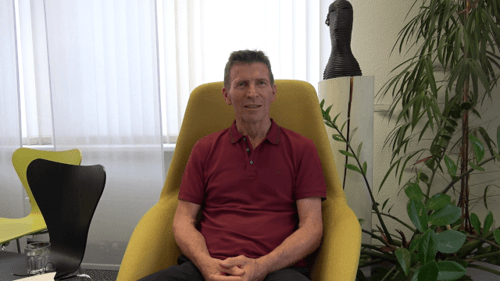
Theo I.
Theo I. was diagnosed with Parkinson's disease at the age of 42. Together with Salome G.-I., he has two small children at this time. Due to the slow progression of Parkinson's disease, he does not have to change his usual lifestyle from one day to the next and can still fulfil family duties, such as childcare. At the time of the interview, he has been living with the disease for twenty-three years. Theo I. works as an organisational consultant. Sport and exercise play a central role in his life. In 2018, he started deep brain stimulation therapy. Age at the time of diagnosis: 42 Treatment: Deep brain stimulation Occupation: Office worker Treatment: Deep brain stimulation
VIDEO
New life
Theo I. describes the time immediately after the operation.
Video Interview
TRANSCRIPT
Other experiences by Theo I.
Theo I.
Theo I. was diagnosed with Parkinson's disease at the age of 42. Together with Salome G.-I., he has two small children at this time. Due to the slow progression of Parkinson's disease, he does not have to change his usual lifestyle from one day to the next and can still fulfil family duties, such as childcare. At the time of the interview, he has been living with the disease for twenty-three years. Theo I. works as an organisational consultant. Sport and exercise play a central role in his life. In 2018, he started deep brain stimulation therapy. Age at the time of diagnosis: 42 Treatment: Deep brain stimulation Occupation: Office worker Treatment: Deep brain stimulation
Theo I.
Slow progression
Theo I. is glad that the disease is progressing only slowly and that he can still do sports.
Symptoms and course of disease
Parkinson's disease: deep brain stimulation and duodopa pump
Theo I.
Change in the division of tasks
Theo I.'s wife has increased her workload, but he now does the housework, which gives him more exercise.
Living with Parkinson's disease
Parkinson's disease: deep brain stimulation and duodopa pump
Theo I.
Social contacts
Theo I. increasingly finds social contacts exhausting.
Living with Parkinson's disease
Parkinson's disease: deep brain stimulation and duodopa pump
Theo I.
Sitting for long periods
Theo I. can't sit at the computer much longer.
Living with Parkinson's disease
Parkinson's disease: deep brain stimulation and duodopa pump
Theo I.
Emotionality
Theo I. has become more emotional on the one hand, but feels strong emotions less intensely.
Living with Parkinson's disease
Parkinson's disease: deep brain stimulation and duodopa pump
Theo I.
Decision-making process
Theo I. tells how deep brain stimulation came about.
Treatment with Deep Brain Stimulation
Parkinson's disease: deep brain stimulation and duodopa pump
Theo I.
Irreversible damage
Theo I. is afraid that something will go wrong during the operation and that he will then be even worse off than before.
Treatment with Deep Brain Stimulation
Parkinson's disease: deep brain stimulation and duodopa pump
Theo I.
Putting on the steel frame
Theo I. finds the steel frame uncomfortable to sit on.
Treatment with Deep Brain Stimulation
Parkinson's disease: deep brain stimulation and duodopa pump
Theo I.
New life
Theo I. describes the time immediately after the operation.
Treatment with Deep Brain Stimulation
Parkinson's disease: deep brain stimulation and duodopa pump
Theo I.
Being able to work again
Theo I. can work again.
Treatment with Deep Brain Stimulation
Parkinson's disease: deep brain stimulation and duodopa pump
Theo I.
Fatigue
Theo I. feels more tired after deep brain stimulation than before.
Treatment with Deep Brain Stimulation
Parkinson's disease: deep brain stimulation and duodopa pump
Theo I.
Battery types
Theo I. is glad that he has a non-rechargeable battery that lasts for three years.
Treatment with Deep Brain Stimulation
Parkinson's disease: deep brain stimulation and duodopa pump
© 2000-2021, All Rights Reserved